This is meant to be a stop-gap idea till the city gets its long-awaited, well-deserved AC Locals, but even then, this is a terribly executed idea.

Anyone who has travelled in a Mumbai local train knows how extremely hot and humid it gets inside, and the doors are a major source of fresh air. Shutting them off completely, with glass panes at that, will make things uncomfortably worse.

Moreover, the window design is terrible — the glass pane sits in the middle, exactly where the seats are aligned. Whoever finalized this design most likely sits in an AC cabin up-north and has never travelled in a Mumbai local train.

Eric Berger, writing for Ars Technica:

The $1.5 billion synthetic aperture radar imaging satellite, a joint project between NASA and the Indian space agency ISRO, successfully launched into orbit on Wednesday aboard that nation’s Geosynchronous Satellite Launch Vehicle, a medium-lift rocket.

The mission, named NISAR (NASA-ISRO Synthetic Aperture Radar), was subsequently deployed into its intended orbit 464 miles (747 km) above the Earth’s surface. From this Sun-synchronous orbit, it will collect data about the planet’s land and ice surfaces two times every 12 days, including the infrequently visited polar regions in the Southern Hemisphere.

NISAR (NASA-ISRO Synthetic Aperture Radar) is a collaborative mission between NASA, the U.S. space agency, and ISRO, India’s space agency. While the launch was successfully carried out by ISRO using its reliable launch vehicle, the satellite itself—equipped with both L-band and S-band Synthetic Aperture Radar systems—was developed jointly by NASA and ISRO. It’s unclear why Eric at Ars Technica chose to describe it as a launch “for NASA,” given the mission’s deeply collaborative nature.

Kiran Rathee, reporting for the Economic Times:

Starlink has become the latest entrant to get a satcom licence in India, becoming the third player after Eutelsat-OneWeb and Jio-SES combine to offer commercial services in India.

The Department of Telecommunications (DoT) has issued the Global Mobile Personal Communication by Satellite (GMPCS) permit to the Elon Musk-owned company and trial spectrum too will be issued to it in coming days.

Starlink is the third company to get the license, after Eutelsat OneWeb and Reliance’s JioSpaceFiber. It’ll be interesting to see how this space shapes up in the coming months.

Meera Emmanuel, reporting for Bar and Bench:

Justice M Nagaprasanna issued the direction while dealing with a petition filed by a company named M Moser Design Associates India Private Ltd (petitioner) after vulgar emails about its employee were sent using Proton Mail to other employees and the company’s clients.

and

Representing the Central government, Additional Solicitor General (ASG) Aravind Kamath had earlier told the Court that the Centre may have a limited role in giving effect to the petitioner’s prayers concerning investigation into the emails regarding its employee with the cooperation of Swiss authorities.

Jagmeet Singh has some additional bit of reporting over on Techcrunch:

Last year, the police department of the southern state of Tamil Nadu had sought to block Proton Mail after the email service was found to have been used for sending hoax bomb threats to local schools. The Indian government’s IT ministry reportedly notified internet providers to block Proton Mail at the request of law enforcement. However, the Swiss federal authorities intervened to prevent the blocking of Proton Mail taking effect.

Airtel’s Spam Warning Feature Gets Two Important Updates

Airtel AI Spam Warning

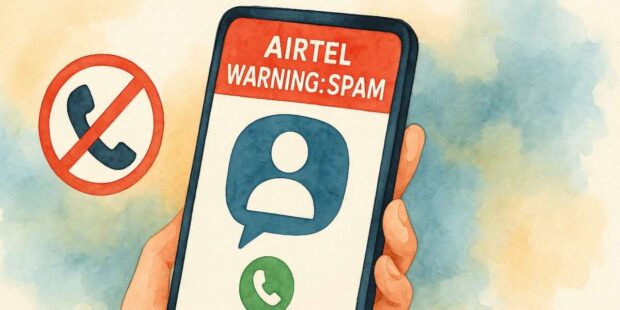
Late last year, Airtel started rolling out a new anti-spam feature across its network — a backend AI system that flags potentially suspicious phone calls and text messages, displaying a simple “Airtel Warning: SPAM” tag on your screen when such activity is detected for incoming calls and SMS messages.

It’s one of those rare telecom upgrades that quietly improves day-to-day usability without requiring any action from the user. And it seems to have had some real impact. In an email sent to customers this week, Gopal Vittal (VC and MD, Airtel) shared that since the feature launched in September 2024, Airtel’s systems have flagged over 27.5 billion calls and more than 500 million SMS messages as suspicious.

The spam warning feature is now getting two notable enhancements:

1. International Spam Call Detection

According to Airtel, scammers quickly adapted to the initial rollout by switching to international numbers to continue spamming users. As a result, the telco says there’s been a 12% increase in spam calls originating from overseas in the last six months.

To counter that, Airtel has now extended its spam detection capability to international numbers as well. Starting April 21, 2025, users will see the same “Airtel Warning: SPAM” label even when the suspicious call is coming from outside India.

“Spammers started adopting even more innovative methods… using international numbers to make spam calls,” said Gopal Vittal. “We have enhanced our AI tool to now identify and mark suspicious numbers as spam, even from international locations.”

2. Spam Alerts in Regional Languages

Airtel also announced that spam warning messages will now appear in a range of Indian regional languages, based on user preference or system language. Supported languages include Hindi, Marathi, Bengali, Gujarati, Tamil, Telugu, Kannada, Malayalam, Urdu, and Punjabi, along with English.

This is a smart move — not everyone processes alerts in English effectively, especially when quick decision-making is needed to avoid a scam call.

“Many of you have told us to alert you in the language that you are comfortable in,” said Vittal. “This is why our spam warnings will now be communicated in [these languages] besides English.”

Airtel says it’s continuing to evolve this system based on usage patterns and feedback. If nothing else, it’s a sign that mobile networks are finally beginning to take the spam problem seriously — and putting actual tech muscle behind solving it.

Hopefully the improvements keep coming, at least enough that we no longer need to rely on Truecaller. I wonder if we’ll see something similar from Jio too in the coming months.
After several years of ignorance, Apple has finally launched the Apple Store app for iPhone and iPad in India. This comes five years after the launch of the Apple Store online in 2020, and follows the opening of its first physical Apple Store in Mumbai in 2023.

Note that this wasn’t just an availability problem — even if you downloaded the Apple Store app from any other region, you could not select ‘India’ as a country in the app. Apple has now officially enabled support for India in the App Store app.

After Mumbai and New Delhi, Apple is planning to launch physical stores in Bengaluru, Pune, Delhi-NCR and another one in Mumbai.

Manish Singh, reporting for TechCrunch:

The Indian Ministry of Home Affairs issued removal orders for the apps, according to a document reviewed by TechCrunch and a disclosure made by Google to Lumen, Harvard University’s database that tracks government takedown requests globally.

The daft dumbos are at it again.

Aditya Kalra, reporting for Reuters:

An investigation by India’s antitrust body has found that Apple exploited its dominant position in the market for app stores on its iOS operating system, engaging “in abusive conduct and practices”, a confidential report seen by Reuters showed.

and

The CCI’s investigations unit, in its 142-page report which is not public but was seen by Reuters, said Apple wields “significant influence” over how digital products and services reach consumers, especially through its iOS platform and App Store.

“Apple App Store is an unavoidable trading partner for app developers, and resultantly, app developers have no choice but to adhere to Apple’s unfair terms, including the mandatory use of Apple’s proprietary billing and payment system,” the CCI unit said in the June 24 report.

Apple has been facing increased scrutiny in recent times in many parts of the world, some of which have forced the company to make important changes to its billing system on the App Store. While I’m off the opinion that Apple’s billing policies are too staunch, they’re in no way a dominant player in the market where Google’s Android and similar billing policies have traditionally held strong ground.